01 / The complete delivery system
Many stories. One continuing direction.
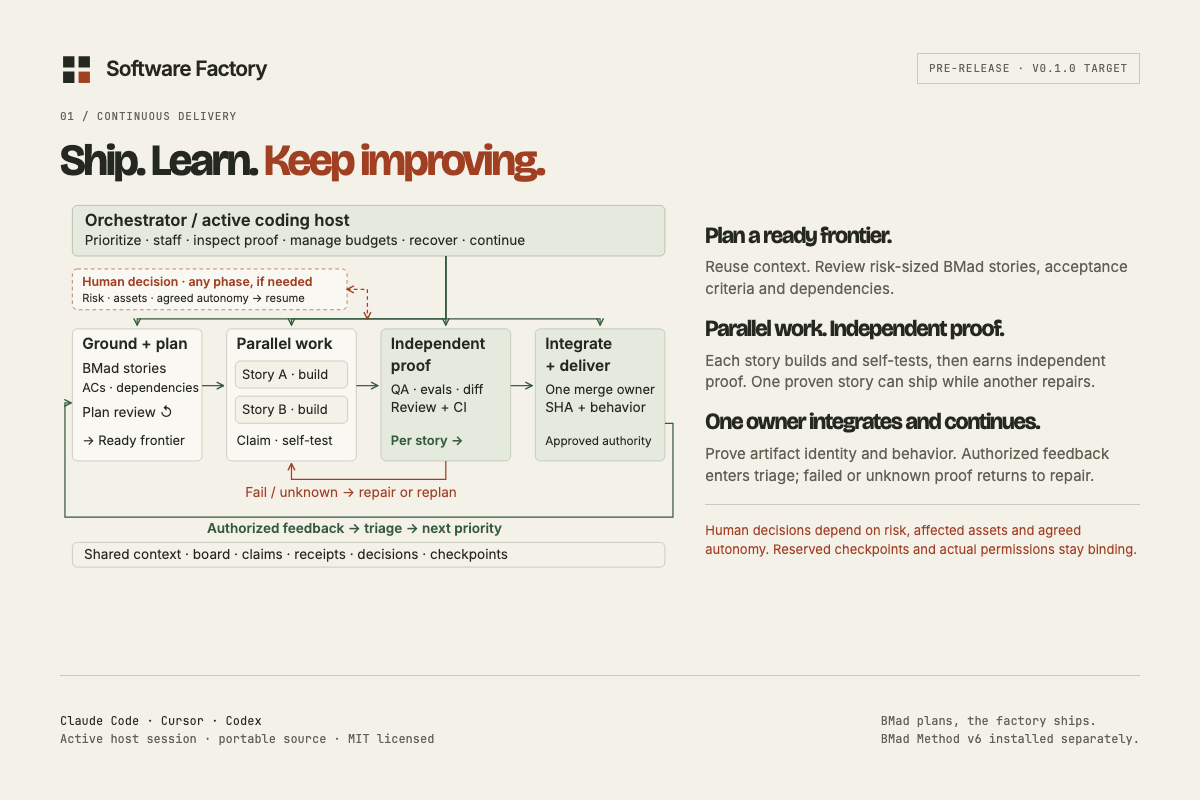
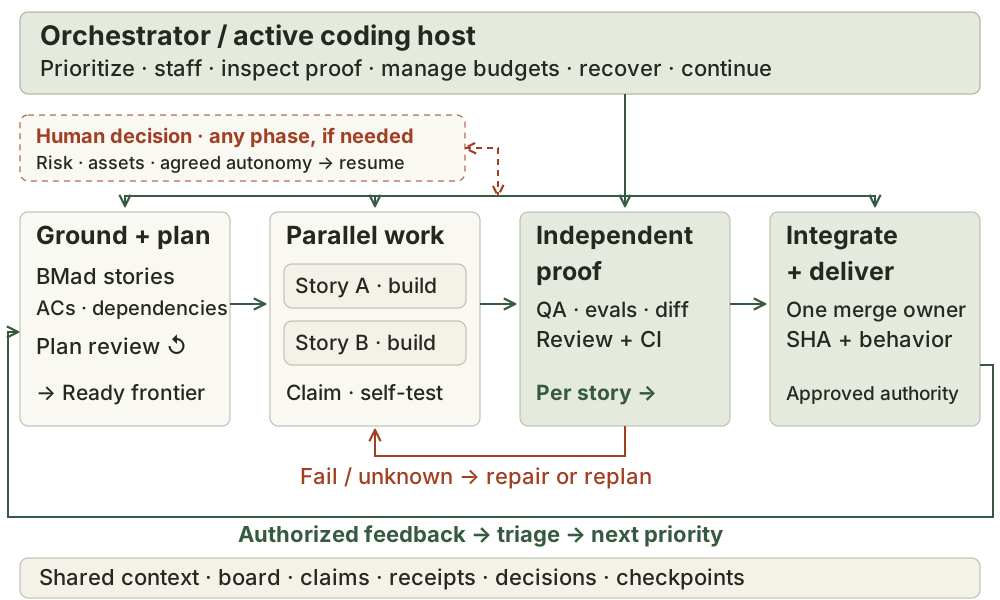
The orchestrator keeps the ready work moving across planning, parallel delivery, independent proof and feedback. These views explain the architecture; recorded status lives in the project board.
01 / Ground → ready frontier
Reuse context. Review the plan.
Ground the outcome in current code, principles and existing requirements and architecture. Use risk-sized BMad epics and stories with acceptance criteria, dependencies and proof. An independent plan reviewer sends material gaps back for revision; missing product or contract decisions get the expertise they need.
The orchestrator selects the ready frontier from dependency evidence, reuses applicable authority and replans when evidence changes.
02 / Independent eligible stories
Staff parallel work as capacity opens.
The orchestrator chooses available agents and models, claims exact paths and owns budgets and recovery. Each worker implements, tests, self-reviews and repairs. Independent stories progress concurrently; conflicting paths and shared resources serialize only the contending phase.
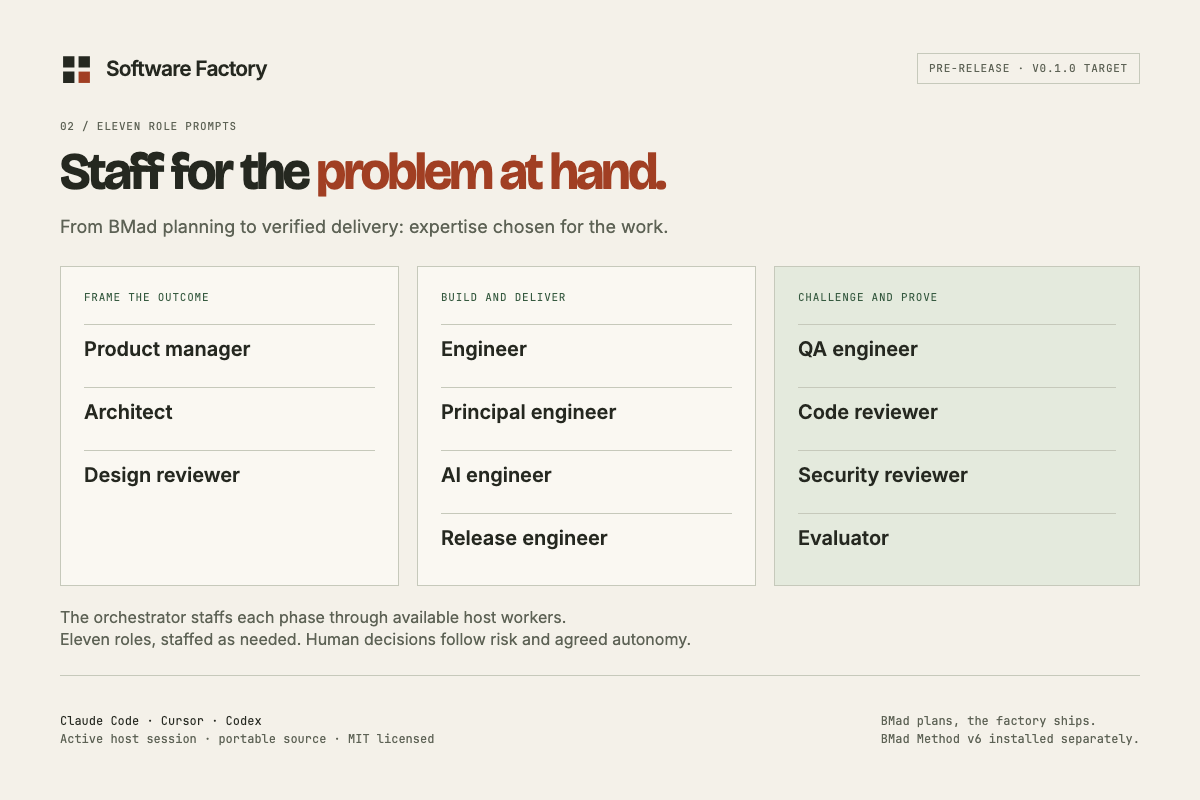
Host capabilities vary. The eleven roles are a starting team staffed as needed.
03 / Per-story evidence + return paths
Prove each result independently.
Independent QA exercises actual effects and story evals. Actual-diff review, CI and configured review dispositions bind to the current subject. Failed, missing, stale or unknown proof returns to the owning worker for corrective work and fresh proof, or to planning when the approach must change.
One proven story can advance while another repairs. There is no global all-workers barrier.
04 / Single-owner integration → proven effect
Integrate in order. Prove delivery.
One owner integrates proven stories sequentially after dependency closure and checks the combined result. Release, deployment or approved local staging needs approved authority, exact artifact identity and affected-behavior proof.
Failed or unknown delivery proof reopens affected work. Reconcile the provider’s actual state before retrying an uncertain external effect. Epic acceptance follows current proof, agreed policy and reserved human decisions.
05 / Authorized signals → triage → plan
Turn evidence into the next priority.
Observation is scoped and off by default. Within approved access and a bounded window, attribute signals, deduplicate reports and reproduce safely. Confirmed bugs enter a risk-sized fix with regression proof. Unknown mechanisms lead to separating experiments and fresh evidence.
Evidence-backed no-fix closure receives independent disposition review without fabricated implementation, merge or deployment. New needs enter planning; recurrence creates linked follow-up work. Re-observe affected behavior after delivery.
06 / Interruption → reconcile → resume
Resume from facts that still hold.
Save bounded checkpoints at meaningful transitions. After interruption, reconcile Git, workers, claims, decisions, provider outcomes and evidence freshness before resuming authorized work. A checkpoint preserves context; it grants no new authority.
Repeated rework can become a bounded factory improvement proposal: independent review and canaries precede authorized application, then observation supports retention or rollback through the same delivery loop.
Shared throughout / durable project facts
One owner for each kind of record.
Principles, architecture and BMad sources ground the work. Board records own live story status; claims own path assignments. Git subjects, receipts, decisions and checkpoints preserve proof and continuity.
The active coding host executes. The derived board and lifecycle graph provide evidence navigation and never dispatch agents. A diagram illustrates these relationships; it does not prove runtime behavior.